
What is EFT - Emotional Freedom Techniques
You have an important meeting coming up, you are about to speak in front of a crowd, or you have been riding a wave of stress all day long. We have probably all experienced it at some point—a knotted stomach, a racing heart, an inability to focus, and a thousand catastrophic scenarios running through your head. Will you reach for coffee? Chocolate? A drink? Or do you just want to run away from it all? But what if there was another way to reduce this stress response without any negative side effects?
What is EFT - Emotional Freedom Techniques
A Method Connecting Modern Psychology with Chinese Medicine
You have an important meeting coming up, you are about to speak in front of a crowd, or you have been riding a wave of stress all day long. We have probably all experienced it at some point—a knotted stomach, a racing heart, an inability to focus, and a thousand catastrophic scenarios running through your head. Will you reach for coffee? Chocolate? A drink? Or do you just want to run away from it all? But what if there was another way to reduce this stress response without any negative side effects?
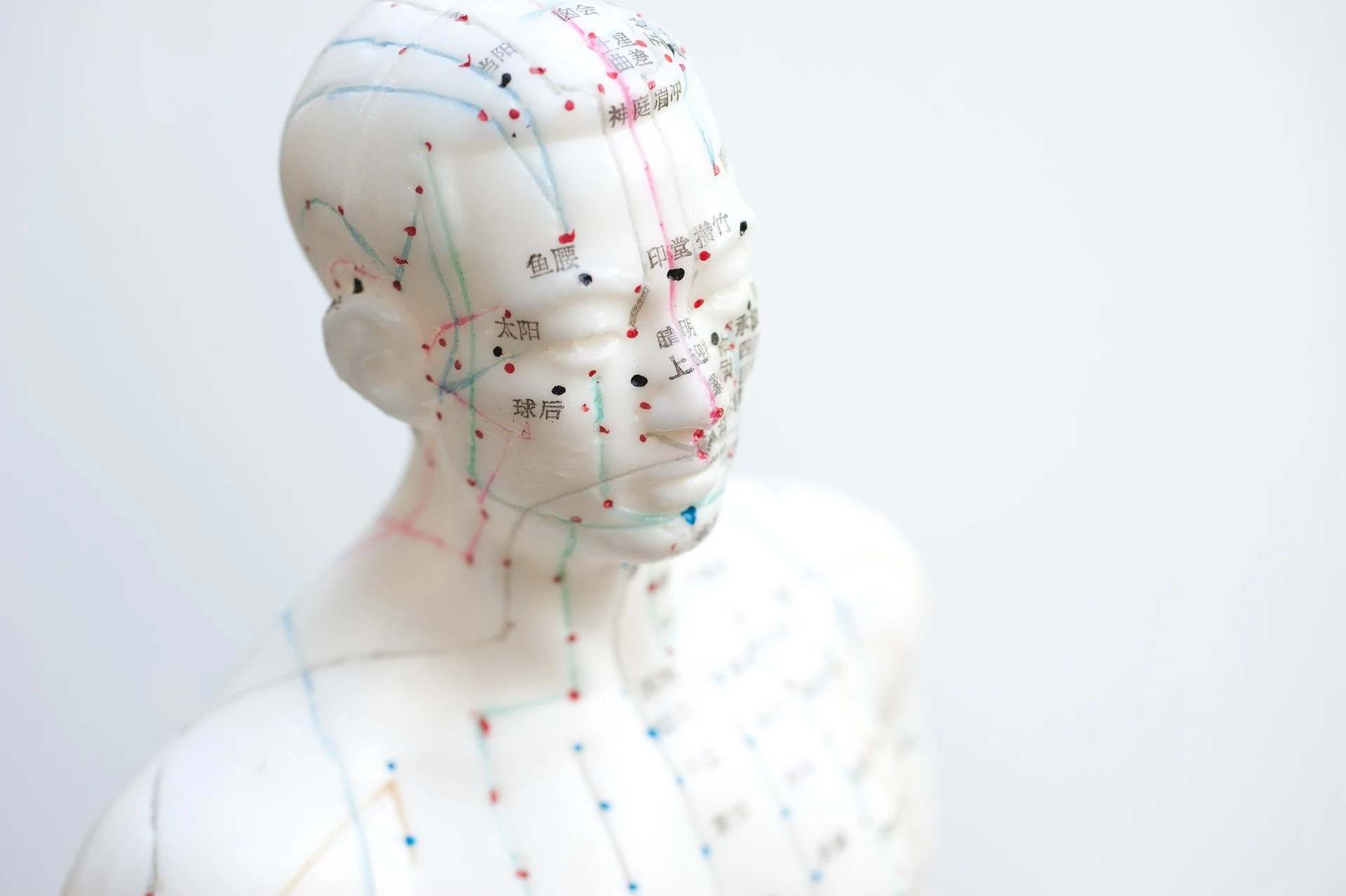
Introducing EFT (Emotional Freedom Techniques), commonly referred to as tapping. EFT falls under the broader family of energy psychology and energy medicine. Put very simply, it works with the body’s energy system (meridians) and today stands as one of the simplest and most thoroughly researched tools for working with the human mind and emotions.
How EFT Was Born
Although the method might not be as widely known yet in some regions and is only beginning to gain mainstream attention, the roots of EFT trace back to the 1980s to an American psychologist named Dr. Roger Callahan. He developed a method called TFT (Thought Field Therapy). It was based on the premise that the root cause of all negative emotions and psychological distress is a disruption in the body's energy system (meridians). TFT was groundbreaking at the time, but it was quite complex for the average person—for every specific problem, whether it was fear of heights, anger, or sadness, you had to tap a completely different, precisely prescribed sequence of points, making it complicated just to figure out where to begin.
In the 1990s, Callahan’s student, a Stanford-trained engineer named Gary Craig, stepped in. Applying his technical mindset, he realized that the entire system could be significantly simplified without losing any of its effectiveness. Craig created a universal sequence of points that is much easier to learn and apply.
He took the best of both worlds, and EFT was born:
- Modern Western Psychology: Focusing attention on a specific problem (exposure therapy) along with its self-acceptance and processing (cognitive therapy).
- Traditional Chinese Medicine: Stimulating the energy pathways (meridians) used in acupuncture. However, instead of needles, you use only the fingertips of your own hands—making it a form of acupressure.
When this energy flows freely through the body's meridians, we feel healthy and full of vitality. When it becomes blocked due to stress or trauma, disharmony occurs, and we begin to experience various undesirable states such as anxiety, physical pain, burnout, and more. EFT helps dismantle these blockages.
How the Body Responds to Stress
We won't dive into deep biology, neurology, or sophisticated epigenetics here. However, to help you understand that EFT is not esoteric "woo-woo" but a method with a solid scientific foundation, let’s take a quick look at how our nervous system operates.
The human defense mechanism was evolutionarily designed to alert us in the face of danger and save our lives. Today, we are usually no longer hunted by wild animals on the street, nor do we have to fight predators for food. Yet, the human brain cannot reliably distinguish between an actual physical threat (a tiger attack) and a perceived psychological threat (fear of a presentation at work, an argument with a partner, or anxiety about the future).
Our limbic system encodes all negative experiences carrying a heavy emotional charge and attaches metaphorical "red flags" to them. It does this to warn us of potential danger in the future. This explains why situations that even remotely remind us of old disappointments, unpleasant events, or past traumas instantly trigger an equally powerful defensive response.
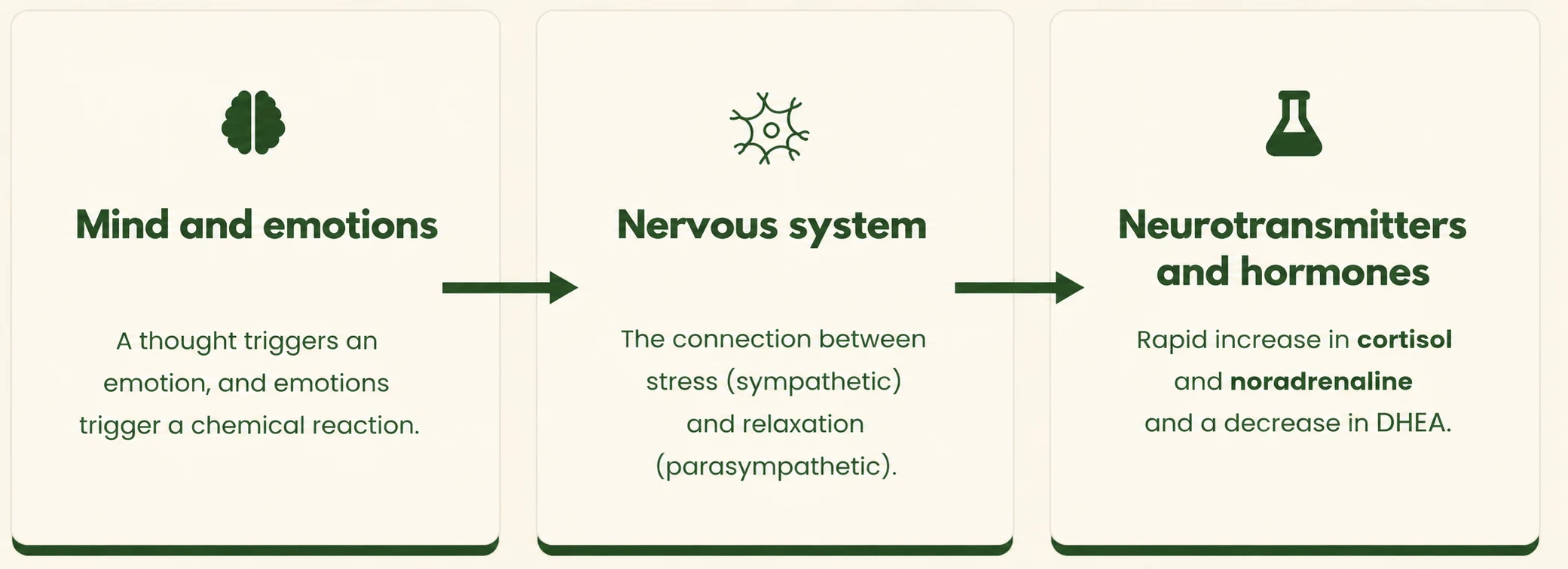
Whenever we find ourselves in such a situation—or even just think about it intensely—a warning center in the brain called the amygdala is instantly activated. It switches the organism into an emergency "Fight-or-Flight" mode. The sympathetic nervous system takes over, the body shuts down functions that are "non-essential" at that moment (such as digestion or logical reasoning), floods the bloodstream with the stress hormone cortisol, muscles tense up, and the heart begins to pound furiously. You are in full battle readiness. Your organism behaves as if you are being attacked by a saber-toothed tiger, even though you might just be sitting in an office facing a presentation or feeling provoked by your boss.
Why EFT Yields Such Good Results
This entire neurobiological process is absolutely fascinating, but to understand the power of EFT, we only need to know how we can influence it. And here lies the answer to the most frequent question: “Why do we keep repeating the negative thing over and over while tapping? Shouldn't we think positively instead?”
This is where the connection to classical psychology comes in—specifically to exposure therapy. If we avoid our fear or problem (or try to override it with forced positive thinking), it actually remains active and unresolved in the subconscious. EFT requires us to face it directly—to "expose" ourselves to it and fully acknowledge the accompanying emotion in the body.
The magic happens the moment we begin to stimulate the meridian points on the body (by gently tapping on them) while in this state of full stressor activation—when your body is actively reacting to a stressful situation or memory. By doing this, we send a completely opposite, calming signal through the nervous system to the brain: “Everything is fine, I am safe, nothing is going to eat me.”
At that exact moment, the brain receives two conflicting inputs simultaneously:
- The thought of the stressor (exposure), which says: Panic!
- The physical signal of calm from the body, which through tapping says: Peace. Everything is fine.
As a result, the amygdala's alarm mode instantly turns off, and the old, dysfunctional neurological pathways in the brain are disconnected. The brain simply rewrites the situation. While we cannot erase the past or the event itself, we can 100% neutralize the information and the emotional charge it carries! The next time you remember that problem or memory, you will still have it in your head, but your body will no longer react with panic, anxiety, anger, a knotted stomach, or any other unwanted emotion. It will be at peace.
A Method Verified by Scientific Data
EFT has long outgrown the category of mere experiments or "alternative therapies." Today, it is backed by hard scientific data and hundreds of clinical trials. Respected organizations, such as the American Psychological Association (APA), list EFT as a method that fully meets the strict criteria for empirically supported treatment across various psychological diagnoses.
In the United States (USA), the method is routinely recommended by doctors in private clinics as well as within government institutions. It has become an approved part of programs within the Department of Veterans Affairs (VA), where it is applied with extraordinary success to treat Post-Traumatic Stress Disorder (PTSD) in war veterans.
In Australia, if a therapist holds a proper license (for example, as a registered clinical psychologist), they can legally integrate EFT into their practice as a complementary, evidence-based method with proven results.
Today, EFT represents a safe and internationally recognized bridge between modern psychotherapy and somatic-emotional work, helping people effectively manage stress, trauma, and chronic issues.
What Can EFT Help With?
EFT works wonderfully for reducing or completely dismantling acute stress; it is a perfectly healthy "pill" for a bad mood. Given that most of our problems, blocks, and even physical symptoms have roots in unexpressed emotions and chronic stress, tapping can help with a wide variety of issues:
- Anxiety and Stress: More than 100 clinical studies confirm that EFT demonstrably and rapidly lowers levels of the stress hormone cortisol.
- PTSD and Trauma: Veterans and survivors of severe life events find immense relief in EFT. It allows for the safe processing of heavy life events or past memories without forcing the client to go through painful re-traumatization.
- Chronic Pain and Physical Symptoms: By clearing the emotional component (as almost every physical pain carries an emotional element) and releasing tension, EFT frequently brings a demonstrable reduction in physical pain.
- Phobias and Fears: Fears of spiders, heights, or flying can often be resolved within just a few sessions.
- Stage Fright and Performance Anxiety: Athletes, executives, and artists use EFT right before an event to clear nervousness and boost focus.
- Addictions and Emotional Eating: It helps unpack and rewrite the underlying emotions driving emotional eating, cravings, or other escapist habits.
- Limiting Beliefs: It helps rewrite subconscious programs like "I am not good enough," "I have to struggle to earn money," or "Nothing ever works out for me," which paralyze us and block our true potential.
How to Use EFT
Yes, it might look quite strange, perhaps even absurd at first. When you see someone tapping their fingers under their nose or on their head while talking for the first time, you might wonder if they’ve lost their mind, and it is hard to believe that something so simple could have a deep therapeutic effect. However, once you experience it for yourself and feel that heavy emotion or knotted stomach simply fall away, it won't seem strange to you at all.
The actual process of basic EFT is very straightforward. It consists of identifying the problem, rating its intensity on a scale from 0 to 10, and then tapping through a specific sequence of points while repeating reminder phrases.
- Identify the problem: Pinpoint what is bothering you right now (e.g., "I feel terribly nervous about tomorrow's exam"; "My spouse totally set me off today").
- Rate the intensity: How strong is the emotion connected to it on a scale from 0 to 10? (Where 10 is the absolute highest).
- The Setup Statement: You tap on the side of your hand (the Karate Chop point) and repeat a sentence three times where you acknowledge the problem while simultaneously accepting yourself (or the problem): "Even though I feel terribly nervous about tomorrow's exam, I deeply and completely accept myself."
- Tap through the points: Go in a loop through the specific points on your body and repeat a reminder phrase ("This anxiety... this fear that I'll fail...") to keep your focus locked on the issue.
- Re-evaluate: Take a deep breath and check the intensity on the 0–10 scale again. Did the intensity of the emotion drop? Awesome. If it hasn't dropped all the way (down to a 1 or 2), do another round.
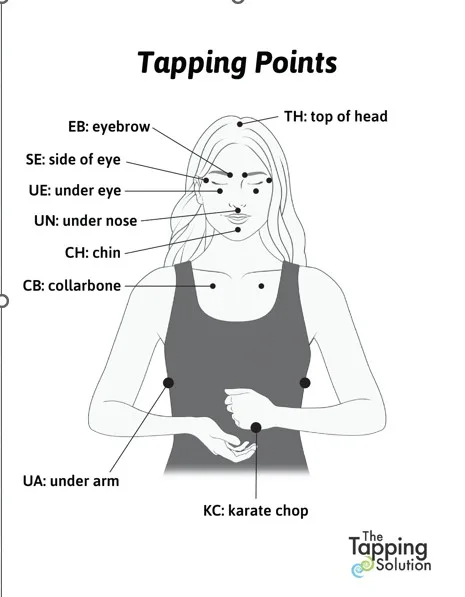
Image courtesy of The Tapping Solution
- Karate Chop (KC) – The side of the hand / wrist (the fleshy part of the outer edge of the hand between the pinky finger and the wrist, where you would deliver a karate chop).
- Top of Head (TH) – The crown of the head (directly on top).
- Eyebrow (EB) – The inner beginning of the eyebrow (just above the bridge of the nose).
- Side of Eye (SE) – On the outside of the eye (directly on the bone of the eye socket, not on the soft temple).
- Under Eye (UE) – Under the eye (on the bone of the eye socket, centered under the pupil, slightly closer to the nose).
- Under Nose (UN) – Under the nose (right in the crease between the nose and the upper lip).
- Chin Point (CH) – Between the lower lip and the chin (directly in the depression below the lip).
- Collarbone (CB) – Under the collarbone (about 1–2 cm down from the collarbone and 1–2 cm out to the side from the breastbone).
- Under Arm (UA) – The underarm (on the side of the body, exactly at nipple level—for women, where a bra strap runs).
Want to Go Deeper?
For quick relief after an argument or a stressful day, EFT works brilliantly as a self-help tool at home. Once you learn a few tapping rounds, you can manage many everyday emotions on your own. It requires no expensive equipment or years of training.
However, if you are carrying deep-seated blocks, traumas that you might not even be consciously aware of, or chronic health issues, it is always best and safest to work with a professional. A certified EFT therapist can safely guide you through intense emotions, use precise questioning to lead you directly to the root of the problem, and apply advanced techniques that you wouldn't open up on your own at home.
At HoliSpot, we are happy to connect you with verified and experienced EFT practitioners in your area.
[Find an EFT practitioner on HoliSpot →]
What to Explore Next
- Want to know which large family of methods EFT belongs to and how the human bioenergetic field works?
- Check out our article: [What Is Energy Medicine].
- Curious about the difference between tapping at home on your own using a video versus evidence-based clinical work with a therapist?
- Read more here: [The Difference Between Classical EFT and Clinical EFT].